
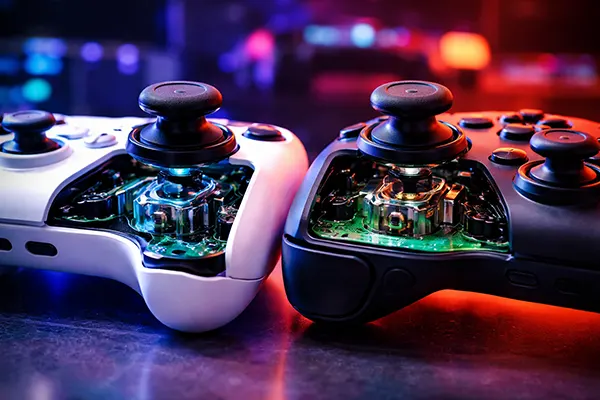
TMR vs Hall Effect Sticks in Controllers: Do New Gamepads Really Solve Drift?
Stick drift has become one of the most discussed hardware issues in modern gaming, especially with the widespread use of analogue sticks in competitive and casual play. As manufacturers search for long-term solutions, two technologies have come into focus: Hall Effect sensors and the newer TMR (Tunnel Magnetoresistance) approach. Both claim to eliminate the mechanical wear that causes drift, but in practice the differences are more nuanced. This article breaks down how each technology works, where they differ, and whether TMR truly represents a meaningful step forward for players in 2026.
How Hall Effect and TMR Sticks Actually Work
Hall Effect sticks rely on magnetic sensors instead of physical contact to detect movement. Instead of using potentiometers that wear down over time, a magnet attached to the stick moves relative to a sensor, which measures changes in the magnetic field. This reduces friction and significantly extends the lifespan of the component. In recent years, this technology has been adopted in controllers like the Gulikit KingKong series and certain custom Xbox and PC controllers.
TMR sticks take a similar idea but refine the sensing method. Tunnel Magnetoresistance sensors are more sensitive to magnetic field changes than Hall sensors. This allows them to detect smaller, more precise movements with less electrical noise. In theory, this results in better accuracy and lower latency, particularly important for competitive gaming scenarios where micro-adjustments matter.
From a hardware perspective, both technologies eliminate the traditional weak point of analogue sticks — the physical contact layer. However, TMR components are more complex and currently more expensive to manufacture, which is why they are still limited to newer or premium devices in 2026. :contentReference[oaicite:0]{index=0}
Key Technical Differences That Affect Gameplay
The main difference between Hall Effect and TMR lies in sensitivity and signal clarity. Hall sensors provide stable input but can sometimes show minor fluctuations due to environmental factors like temperature or electromagnetic interference. These variations are usually small but can become noticeable in precision-heavy games such as FPS or racing simulators.
TMR sensors, on the other hand, offer a stronger signal-to-noise ratio. This means cleaner input data and fewer micro-jitters when the stick is idle. For players who rely on fine aiming control, such as in esports titles, this can translate into smoother crosshair movement and more predictable input response.
Another difference is power efficiency. TMR sensors typically consume less energy, which is a relevant factor for wireless controllers. While the impact on battery life is not dramatic, it contributes to overall optimisation in modern gamepad design.
Do These Technologies Really Eliminate Stick Drift?
One of the biggest claims around both Hall Effect and TMR sticks is that they solve drift entirely. In reality, they address the primary cause — mechanical wear — but not every possible source of drift. Dust, manufacturing tolerances, and firmware calibration still play a role in how a controller behaves over time.
Hall Effect sticks have already proven to be far more durable than traditional potentiometer-based designs. Reports from long-term users show minimal degradation even after extensive use. However, minor calibration drift can still occur, especially if the controller experiences physical impact or environmental stress.
TMR sticks aim to reduce even these minor inconsistencies. Thanks to higher precision, they require less aggressive deadzone calibration. This means that even after prolonged use, the controller can maintain tighter responsiveness without needing software compensation.
Real-World Performance in 2026 Controllers
In practice, the difference between Hall Effect and TMR is noticeable mostly to experienced players. Casual users will likely find both technologies equally reliable compared to older designs. Drift-related issues become rare enough that they are no longer a major concern in day-to-day use.
Competitive players, however, may notice that TMR sticks feel more consistent near the centre position. This is where traditional sticks — and even Hall Effect ones — sometimes struggle with micro-input stability. TMR reduces this problem, which can be important in games requiring pixel-level adjustments.
That said, implementation matters more than the sensor type alone. A poorly tuned TMR controller can perform worse than a well-designed Hall Effect one. Firmware, build quality, and calibration algorithms remain critical factors.

Is TMR the Future or Just a Premium Upgrade?
TMR technology is clearly positioned as the next step in controller evolution, but it is not yet the industry standard. As of 2026, most mainstream controllers still rely on potentiometers or, increasingly, Hall Effect sensors. TMR remains more common in niche or enthusiast-oriented devices.
The cost factor plays a major role here. TMR sensors are more expensive, and manufacturers must balance performance gains against price expectations. For many users, Hall Effect already provides a substantial improvement over older designs, making it a practical middle ground.
However, as production scales and costs decrease, TMR is likely to become more widespread. The gaming hardware market tends to adopt new technologies gradually, especially when they offer measurable improvements in durability and precision.
What Players Should Choose Right Now
For most players in 2026, choosing between Hall Effect and TMR comes down to priorities. If long-term durability and freedom from drift are the main concerns, Hall Effect controllers already deliver strong results and are widely available.
If precision and input consistency are critical — for example in competitive gaming — TMR sticks offer a noticeable edge. The improvement is not dramatic for everyone, but it is meaningful in scenarios where control accuracy defines performance.
Ultimately, both technologies represent a shift away from the traditional weaknesses of analogue sticks. While TMR may define the next generation, Hall Effect remains a reliable and proven solution that already meets the needs of most players.
Popular articles
-
 PRAGMATA: How Shooting and Hacking Reshape...
Released on 17 April 2026, PRAGMATA places …
-
 XR Headsets of the Next Generation: Are AR...
Extended Reality technology has moved far beyond …
-
 Path of Exile Mobile Review: A Dark ARPG f...
Path of Exile Mobile is one of …