
Touchscreens and Gesture Control in Mobile Gaming: Are They Better Than Controllers?
Mobile gaming has changed fundamentally over the past decade. What was once seen as a simplified alternative to console play is now a fully fledged gaming environment powered by advanced processors, high-refresh displays, and sophisticated input technologies. Touchscreens and gesture control are no longer compromises forced by hardware limitations; they are deliberate design choices shaping how modern mobile games are played.
Precision and Response: Touch Input Versus Bluetooth Controllers
Touchscreens offer direct interaction between the player and the game world. Every tap, swipe, or long press translates instantly into an in-game action, eliminating intermediary hardware layers. Modern capacitive displays sample input at rates exceeding 240 Hz, allowing near-instantaneous response times that rival traditional input devices.
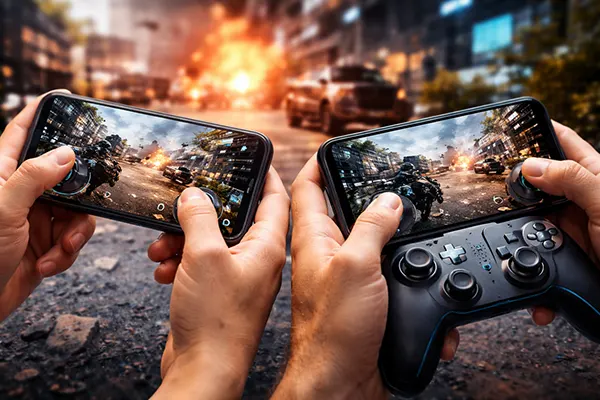
Bluetooth controllers, by contrast, introduce an additional transmission step. Even with low-latency standards such as Bluetooth 5.3, there is still measurable input delay, especially noticeable in fast-paced genres like shooters or rhythm games. While the difference may appear marginal on paper, competitive players often perceive it during precise timing windows.
That said, controllers retain an advantage in tactile consistency. Physical buttons provide clear actuation points, which some players find more reliable for repeated actions. The choice between touchscreen and controller therefore depends not only on latency, but also on how much physical feedback the player requires.
Accuracy in Competitive and Action-Heavy Games
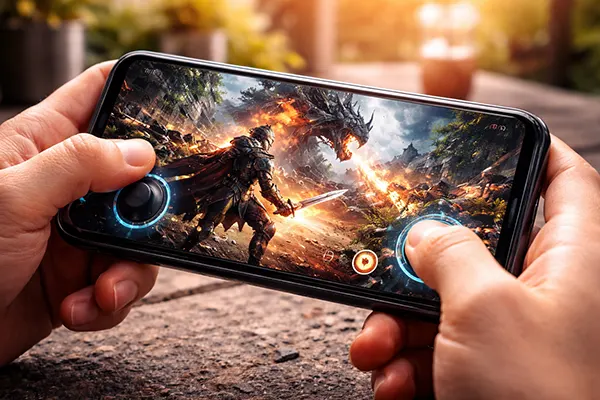
In first-person shooters and action RPGs, touchscreen accuracy has improved significantly through adaptive sensitivity zones and customisable layouts. Developers now allow players to fine-tune dead zones, gesture lengths, and multi-finger inputs, reducing accidental commands and improving aim stability.
Controllers still dominate in scenarios requiring simultaneous directional movement and precision aiming. Dual analogue sticks provide continuous input that touchscreens must emulate through virtual controls. While modern software solutions are effective, they remain approximations rather than true physical equivalents.
Testing across popular titles such as Call of Duty Mobile and Genshin Impact shows that experienced touchscreen players can match controller users in reaction speed. However, the learning curve is steeper, and mastery depends heavily on personal dexterity and screen size.
Modern Smartphones Designed for Advanced Touch Gaming
High-end smartphones released in 2024 and 2025 are explicitly optimised for gaming interaction. Flagship models from Apple, Samsung, and ASUS feature displays with adaptive refresh rates up to 144 Hz and ultra-low touch latency, ensuring consistent responsiveness even during graphically intense moments.
Touch sampling rates have become a key differentiator in gaming phones. Devices such as the ASUS ROG Phone series and Samsung Galaxy Ultra models prioritise sustained performance, preventing input lag caused by thermal throttling during extended play sessions.
Equally important is screen size and aspect ratio. Larger displays allow more comfortable multi-finger gestures and reduce input overlap, directly affecting accuracy in games that rely on complex control schemes.
Gesture Recognition and Software Optimisation
Gesture control extends beyond simple swipes. Modern mobile operating systems support contextual gestures, pressure-based inputs, and edge-zone recognition, enabling developers to map complex actions without cluttering the screen.
Games built with native gesture frameworks show measurable advantages in control clarity. Titles designed specifically for touch input feel more intuitive than ports adapted from console mechanics, reinforcing the importance of software-hardware alignment.
In practice, gesture-first design reduces the need for external accessories. Players can perform advanced manoeuvres using natural hand movements, which contributes to immersion rather than detracting from it.
Real-World Testing in Popular Mobile Games
Benchmarking input methods across real games provides clearer insight than technical specifications alone. In racing games such as Asphalt 9, touch steering with gesture-based drifting offers faster reaction times compared to analogue triggers, particularly on wide screens.
Strategy and card-based games benefit most from touchscreens. Direct selection, drag-and-drop mechanics, and rapid interface navigation outperform controller input, which often feels redundant in these genres.
Even competitive multiplayer environments have adapted. Ranked modes increasingly support touch-only matchmaking, acknowledging that touchscreen players can compete fairly at high skill levels.
When Controllers Still Make Sense
Controllers remain valuable for long sessions where hand fatigue becomes a concern. Holding a device and performing constant gestures can strain fingers over time, whereas controllers distribute physical effort more evenly.
Emulated console titles and legacy game ports also favour controllers. These games were originally designed around physical inputs, and adapting them fully to touch can feel unintuitive despite technical optimisation.
Ultimately, the most effective setup depends on game design rather than hardware superiority. Touchscreens excel when games are built around them, while controllers retain relevance in specific use cases rather than as a universal upgrade.
Popular articles
-
 Nintendo Switch 2 mouse controls: can Joy-...
The upcoming Nintendo Switch 2 introduces a …
-
 Brawl Stars: How to Rank Up Faster by Choo...
Ranking up in Brawl Stars in 2026 …
-
 Home Network for Cloud and Remote Gaming i...
Cloud gaming and remote play are unforgiving: …