
Nintendo Switch 2 mouse controls: can Joy-Con 2 really replace a mouse in real games?
The upcoming Nintendo Switch 2 introduces a new control idea that has already sparked debate among players: mouse-style controls using the updated Joy-Con 2 controllers. Nintendo has confirmed that the controllers can function as pointer devices in compatible software and even within system menus. At first glance this may sound like a minor convenience feature, but in practice it could reshape how certain genres are played on a console. Strategy games, simulation titles and creative tools traditionally rely on mouse precision, something console controllers have struggled to replicate for decades. The question is whether Joy-Con 2 can realistically fill that role without sacrificing comfort or accuracy.
How Joy-Con 2 mouse controls actually work
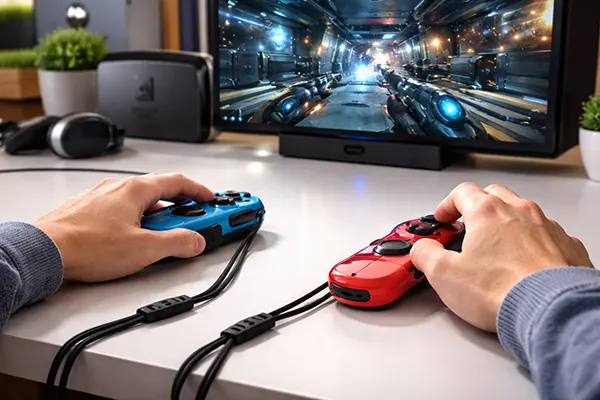
Unlike the traditional analogue stick approach used in most console interfaces, Joy-Con 2 mouse mode is designed to mimic the behaviour of a physical mouse placed on a surface. The controller detects movement across a flat plane and converts that motion directly into cursor movement on screen. Nintendo has stated that the feature can be used both in compatible games and across parts of the system interface, including menus and digital store navigation.
The design also supports one-handed or dual-handed use. A single Joy-Con 2 can function as a basic pointer, similar to a laptop touchpad replacement. Using two controllers simultaneously opens more experimental possibilities, such as controlling separate actions with each hand or managing movement and camera control independently.
This dual input concept could allow developers to experiment with mechanics that simply were not possible with previous Nintendo controllers. Instead of replacing analogue sticks entirely, mouse mode appears intended as an additional control option that games can activate when precision input becomes important.
Where mouse-style controls already make sense
Menu navigation is the most immediate benefit. Consoles connected to televisions often rely on directional inputs that move slowly through interface grids. A pointer system allows players to jump directly to icons, menus and selections without repeated stick movements. For users sitting several metres from a television, that improvement alone could make browsing faster and more intuitive.
Strategy games are another obvious use case. Titles that involve map navigation, tile selection and layered interface menus benefit heavily from precise pointer movement. With a mouse-style controller, selecting units or issuing commands becomes much closer to the experience players expect from PC strategy titles.
Creative software may benefit as well. Drawing tools, editing interfaces and design applications rely on accurate cursor placement. If Joy-Con 2 can maintain stable pointer tracking, it could enable console versions of creative applications that previously required touchscreen or mouse hardware.
Performance and accuracy during gameplay
Early hands-on impressions from journalists and developers suggest that Joy-Con 2 mouse tracking is responsive and relatively smooth. The controller appears capable of translating small physical movements into precise cursor adjustments, which is essential for strategy titles or detailed interface navigation.
However, responsiveness alone does not determine usability. Long-term comfort is equally important. A conventional computer mouse is shaped specifically to support the hand during extended sessions. Joy-Con 2, while compact and versatile, still originates from a portable console design, which means the ergonomics may not match those of a dedicated desktop device.
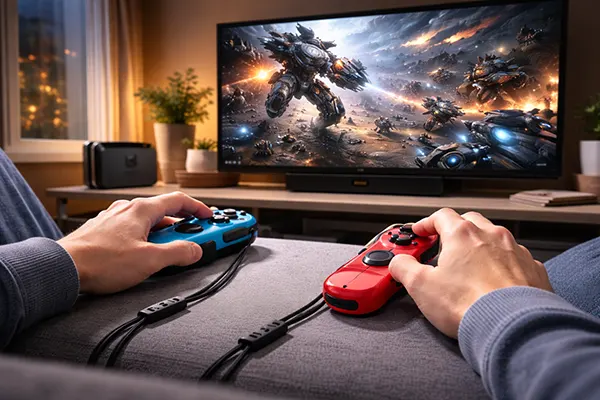
Another factor is surface compatibility. Console players rarely sit at desks with mouse pads. Many play on sofas or armchairs. Reports suggest the controller can function on a variety of surfaces, including fabric and clothing, but stability and precision may still depend on the environment in which the player is sitting.
Comfort and real-world usability
Comfort often determines whether a new control feature becomes part of daily play or remains a novelty. Because Joy-Con 2 is small and lightweight, it can be used casually without the commitment required by a full mouse and keyboard setup. That makes it particularly suitable for short sessions or occasional pointer interaction.
At the same time, extended use may expose limitations. A traditional mouse allows the palm to rest comfortably while fingers handle fine movements. With a Joy-Con 2, players hold the controller rather than resting their hand on it. Over several hours this difference could affect fatigue and control stability.
Developers can mitigate some of these limitations through design choices. Sensitivity adjustments, pointer acceleration options and well-scaled user interfaces can all make mouse-style controls feel more natural even when the hardware is not identical to a desktop mouse.
Can Joy-Con 2 truly replace a mouse?
The answer depends largely on the type of game. In strategy titles, simulation games and interface-heavy software, Joy-Con 2 mouse mode has the potential to replicate most of the advantages of traditional mouse input. Precision selection and faster navigation could significantly improve the console experience for these genres.
For fast competitive shooters or games that demand extremely rapid flick aiming, the situation is more complicated. Dedicated gaming mice offer high sensitivity ranges, adjustable weight and specialised ergonomics designed for sustained performance. Joy-Con 2 is unlikely to match that level of hardware optimisation.
Instead, the controller seems positioned as a hybrid solution. It bridges the gap between console and PC input styles, allowing players to access pointer precision without needing a desk, keyboard or additional accessories.
The realistic role of mouse controls on Switch 2
As of 2026, Joy-Con 2 mouse controls appear to represent an expansion of console control possibilities rather than a full replacement for traditional mouse hardware. They provide a new level of flexibility that could allow developers to bring more complex genres to the console environment.
The real success of the feature will depend on how developers integrate it into their games. If titles are designed around the strengths of pointer input, players may find that the Joy-Con 2 approach feels natural and efficient. If the feature is only added as optional compatibility, it may remain underused.
Ultimately, the most realistic conclusion is that Joy-Con 2 does not need to defeat the traditional mouse to be valuable. By offering a precise pointer option within a portable console system, Nintendo is opening new design space for games that previously struggled to adapt to controller-only input.
Popular articles
-
 Eversoul — Gacha Mechanics and Team Develo...
Eversoul stands out among modern mobile RPGs …
-
Nintendo Switch 2 mouse controls: can Joy-...
The upcoming Nintendo Switch 2 introduces a …
-
 Brawl Stars: How to Rank Up Faster by Choo...
Ranking up in Brawl Stars in 2026 …